
Annual planning: designing press work at the end of the year
Start the new year with strategically sound PR
Annual PR planning is one of those things that, contrary to what experts know better, often falls by the wayside in practice. And not only for beginners. Our experience shows that a structured preparation for the coming year is sometimes neglected even by established companies. Whether it’s trade fair fatigue, restructuring, personal Christmas stress or simply a lack of drive – the specific reasons are as varied as they are, in fact, unacceptable.
Below, we would like to briefly show why sound planning for the coming year is of great value and how it can be implemented in practice despite all obstacles.
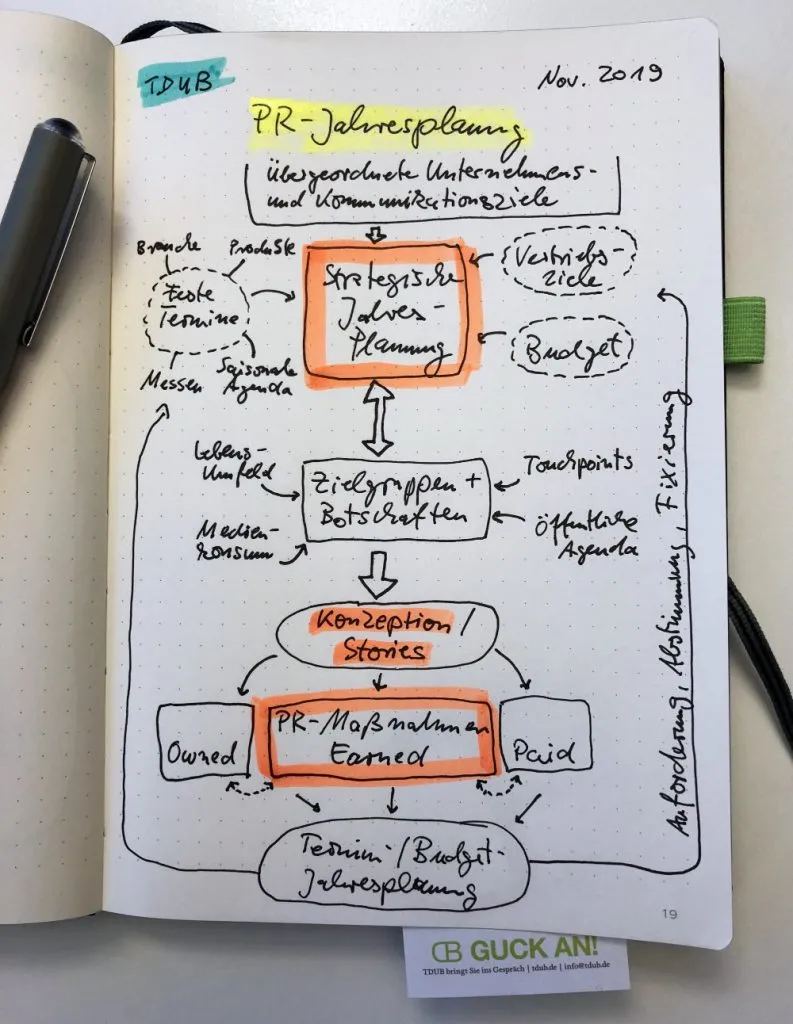
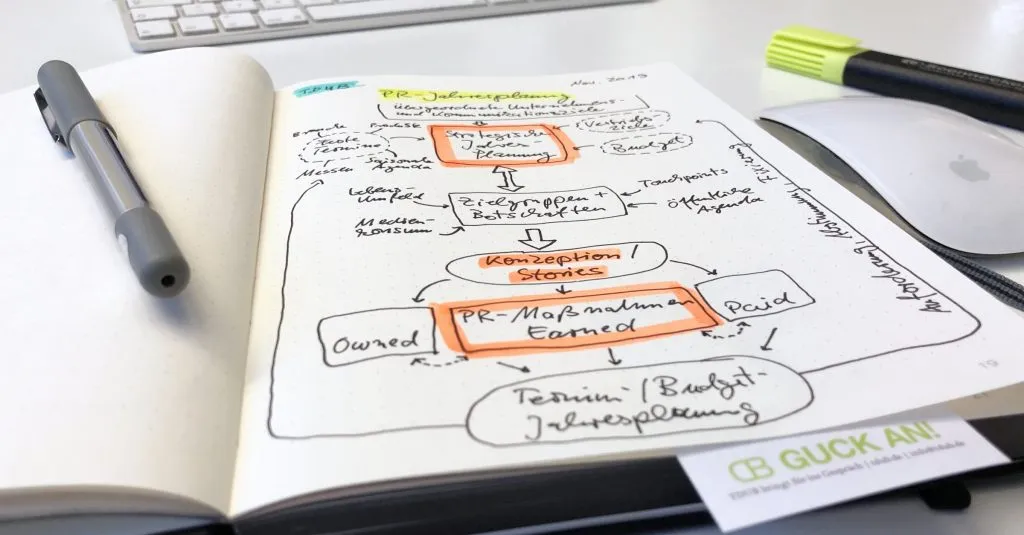
Download: This article with flowchart in a PDF document.
Take stock – and set new goals
When the days grow shorter, it is the right time to look back on the year and review which PR measures have delivered which success. A proactive evaluation by the PR department opens up the opportunity to feed your own insights into planning, rather than being dependent solely on others’ requirements – such as financial planning – or on operational objectives. The business objectives are translated into communication objectives and these are reviewed on the basis of the experiences of the year drawing to a close. In principle, budget requests can only be made once the measures have been designed at the end of the concept phase.
Stay realistic: reach costs money
Why is a planning phase indispensable? Quite simply: if senior management sets the new budgets without prior consultation with those responsible for PR, that will affect whether and how the stated objectives can be achieved. For example, it will be difficult to achieve increased reach if, at the same time, less money is being spent. In that case, it must be explained credibly which new methods are supposed to make such a feat possible. It could be possible if the PR team are also given the freedom to experiment with creative methods. But that also increases the risk of failure – in fairness, everyone involved should know that. It needs to be discussed.
Designing communication is a creative process
In many cases, for annual planning you don’t need to go through the entire concept development process again: target groups, messages and positioning often remain unchanged for years. However, if you imagine the different target groups as personas, their living environment and their media use, you gain valuable ideas for improved communication. Online channels in particular change quickly, and someone who could still be reached on Facebook yesterday might now be on Instagram. Some business customers may have switched from the printed trade journal to the online portal. More strategic planning is of course needed when the new product family is geared towards a completely different target group.
PR annual planning starts from the fixed dates
Yes, we know the problems of collaboration in large or internationally organised companies. Depending on the country, different product launches, regional trade fairs or ineffective communication routines between production, sales and marketing make long-term scheduling difficult. Nevertheless, it is usually possible to estimate when which dates must be planned in as non-negotiable. Sometimes you can also work well here with movable project “placeholders”. Seasonal events such as trade fairs, Black Friday or the Christmas business can also be expected at the same time every year.
Storytelling enables continuous communication
Over the course of the year, there will repeatedly be phases when no topics arise from the product cycle. Those who use these times for long-term planned “campaigns” can deploy resources more efficiently and tap into new reach. The content for this comes from creative “storytelling”: not the product, but the customer’s interests take centre stage. This is where service and advice pieces, infotainment and agenda-setting take place. Media partnerships, big-data analyses and studies, personal branding for the executive board, new research findings or CSR initiatives – if you don’t plan these tools and measures right at the beginning of the year, you certainly won’t be able to muster the effort to do so in the hectic day-to-day.
Define topics, channels and media
In the end, those responsible for PR should honestly assess which topics really have the potential for organic distribution among the relevant target groups (earned media) – these can be pushed with high engagement. For the other topics, you should candidly consider paid media. Or focusing on addressing existing customers via your own platforms (owned media).
A guideline that cannot be unchangeable
This more or less automatically results in an annual plan that should be accepted by everyone involved and serve as a guideline. It probably won’t work without ongoing adjustments over the course of the year. But still: Anyone who makes provisions in this way has created the most important prerequisite for the company to speak with one voice in order to achieve one goal. The PR team can devote itself to its actual tasks throughout the year, instead of constantly having to fight internally to get its ideas and approaches – and the budget – approved.
Yes, annual PR planning is a must.